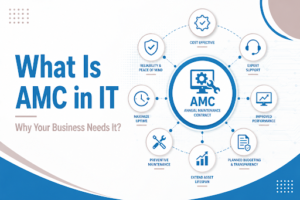
In many organizations, the unpredictability of technology expenses can be a challenge. This is where the role of IT AMC Services (Annual Maintenance Contracts) becomes relevant. An AMC allows organizations to plan their IT expenses while also ensuring that their IT needs are met. But it is necessary to understand the structure of expenses before entering into any agreement.
What Determines IT AMC Pricing?
Prices for AMC are not standard. They are affected by various practical factors related to your infrastructure and the level of service you require.
1. Type of Coverage
- Comprehensive AMC: Includes parts and services.
- Non-comprehensive AMC: Only service charges are covered; spare parts are charged separately.
Comprehensive packages are more costly but lower the chances of sudden repair expenses.
2. Number of Devices
More devices, such as desktops, laptops, servers, routers, and printers, lead to a higher total contract amount. Some suppliers provide pricing based on the quantity.
3. Age and Condition of Equipment
Older equipment may break down more frequently. This means more risk for the service provider, which may reflect in the price.
4. Scope of Services
- Routine maintenance visits
- Emergency support
- Operating system installation and updates
- Network troubleshooting
- Antivirus management
- Data backup support
With more services included, the pricing scheme would be.
Key Contract Terms You Should Understand
It is advisable to thoroughly check the contract before you commit to an AMC. Here are the significant aspects of the contract you should pay attention to:
1. Service Level Agreement (SLA)
SLA spells out the response and resolution time. A case in point:
- Response within 2–4 hours for critical issues
- Next-business-day resolution for non-critical cases
Clear SLAs help in avoiding misunderstandings when emergencies occur.
2. Preventive Maintenance Schedule
Most agreements cover quarterly or bi-annual maintenance visits. Regular servicing reduces downtime and extends the life of the hardware.
Exclusions
Problems are not always covered. Contracts may exclude:
- Physical damage
- Fire or water damage
- Unauthorized software installations
- Consumables such as printer cartridges
Careful reading of the exclusions would help to avoid disputes in the future.
3. Payment Terms
AMC’s fees can be:
- Paid yearly in advance
- Divided into quarterly payments
- Designed according to device categories
Businesses of all sizes are allowed to negotiate payment terms to be more flexible.
Customization and Scalability
Many companies think that AMC contracts are rigid, but in reality, IT AMC Services are often customizable. Businesses can increase or decrease their coverage depending on their expansion, remote work arrangements, or new infrastructure installations.
For instance, some service providers could offer:
- A mix of on-site and off-site help
- Network security monitoring
- Cloud backup integration
- Server health monitoring
Such contract flexibility allows a business to keep up with its growth.
How to Evaluate Cost vs Value
Low pricing should not be the only decision factor. Instead, evaluate:
- Technician expertise
- Availability of genuine spare parts
- Experience with similar industries
- Proactive monitoring approach
- Clear escalation process
A well-planned AMC reduces downtime, increases productivity, and prevents sudden repair costs that can disrupt operations.
Building Long-Term IT Stability
Understanding the pricing and contract terms is essential for companies to take a wise step. A transparent AMC agreement ensures clarity on coverage, responsibilities, and service expectations.
At the first instance, PC Zone IT Services perceives that IT AMC Services should be considered as a tool of prevention to avoid breakdowns, rather than a repair of them. By having a well-structured contract, a proper agreement of the level of service, and a maintenance approach that is not only reactive but also proactive, companies will be able to create a stable IT environment at controlled costs.
When deciding what to choose, a company would most likely look for solutions such as IT support services, annual maintenance contracts for computers, managed IT services for small businesses, IT infrastructure management, and computer maintenance services to get the total coverage of their requirements and be aligned with their operational needs of operation.