Servers play a crucial role in modern business operations, providing the backbone for data management, application running, customer interaction, and day-to-day operations. They’re constantly running in the background, doing things like keeping customer info safe and helping different departments work together. This is the main reason why regular maintenance cannot be seen as an option, but as a necessity. With well-planned server maintenance services, businesses can be assured of continued stable operation, lowered risk of technical issues, and longevity of servers’ performance.
Keeping Business Operations Stable and Predictable
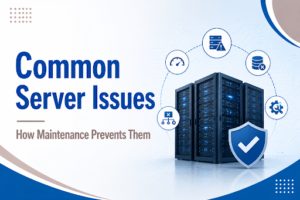
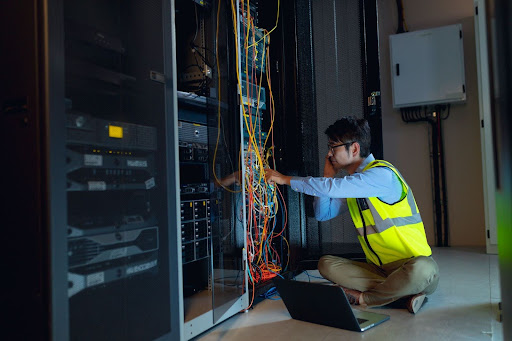
Servers without regular maintenance can easily slow down, heat up, or simply stop working without any prior warning. Such situations usually happen at the most inconvenient moments, like during peak business hours or when handling critical transactions. Moreover, through regular maintenance, a business can spot the minor issues, such as disk errors or firmware revisions that are out of date, and thus, prevent such problems from escalating to the point of disrupting business operations.
Besides that, periodic inspections are helpful in making sure that the system resources are properly allocated. When servers run efficiently, employees can access tools faster, customers experience fewer delays, and teams can focus on productivity instead of troubleshooting technical issues.
Strengthening Security and Reducing Risk
Over time, servers accumulate unnecessary files, fragmented data, and inefficient processes. A system that is not regularly patched and still has an old configuration is basically opening its doors to malware, ransomware, and even unauthorized users. Through maintenance procedures, these hazards can be managed as the updating of the operating systems, security patches, and access controls is a continuous process.
Essential security maintenance tasks usually comprise:
- Checking that only the right users have access and reviewing access logs
- Seeking and instantly applying the necessary security updates
- Detecting unusual server activity
- Ensuring the proper functioning of the firewall and antivirus
These steps significantly reduce the chances of data breaches and compliance issues.
Improving Performance and System Lifespan
Collecting junk files, fragmented data, and inefficient processes are typical server problems that emerge over time. This accumulation, if left unaddressed, will eventually lead to a performance drop. Performing regular system tune-up activities, for instance, disk cleaning, load balancing, and performance tracking, can sustain the smooth running of servers even if the workload is heavier.
Organizations that invest in the regular upkeep of their servers through server maintenance services frequently gain system responsiveness and hardware life extension benefits. This leads to fewer replacements of the hardware components and doubles your organization’s IT budget planning.
Supporting Business Growth and Scalability
The server capacity of the business changes only if the business grows, naturally. Existing systems get overloaded with new users, applications, and data volumes. Maintenance check-ups can reveal whether the infrastructure is capable of dealing with the growth or if the upgrades are inevitable.
Maintenance also supports better planning by:
- Early recognition of capacity constraints
- Making sure the new software is compatible
- Time reduction for downtimes during expansions or migrations
This measure will enable the companies to grow without having technical issues as unexpected obstacles.
A Long-Term View on Reliable IT Operations
From the perspective of PC Zones IT Services, continuous server maintenance is a way of increasing reliability, rather than reacting to failures. Their business practice demonstrates that enterprises derive maximum advantage from maintaining their facilities when the maintenance is more or less a continuous activity rather than a one-time fix. By mixing vigilant oversight with a reasonable set of standard operating procedures, a business entity is able to: secure its data, achieve a high level of uptime, and embrace change with greater assurance. When supported by server maintenance services and aligned with broader IT priorities such as network security, cloud computing, data backup, and IT support services, regular maintenance becomes a foundation for stable and sustainable business operations.